Real time
The server handles hundreds of comments a minute and puts them into the game before a player can put the phone down.
Kvízákov is not a show or a channel. It is software I wrote from scratch: it reads the live event stream from TikTok Live, scores the answers of thousands of viewers in real time and renders a game the whole chat plays at once.

An ordinary livestream is one directional: the host talks, the viewer watches. Kvízákov inverts that relationship. Every chat comment is a game input, every like is a scoring bonus, and every gift fires an effect the whole stream can see. Within two seconds of joining, a viewer becomes a player with a name, an avatar and a place on the leaderboard, with no install, no registration and no click outside TikTok.
Underneath sits a Python server holding the game state and a browser rendering layer whose output goes into the broadcast. A WebSocket runs between them. The whole chain from typing a comment to seeing your vote on screen takes a fraction of a second, otherwise the game would not work at all.
The server handles hundreds of comments a minute and puts them into the game before a player can put the phone down.
A database of 90,018 questions across 230 topics and five difficulty levels. Every question is read out loud by the game.
Fireworks, screen quakes, a music visualiser and a colour scheme driven by the real elevation of the sun.
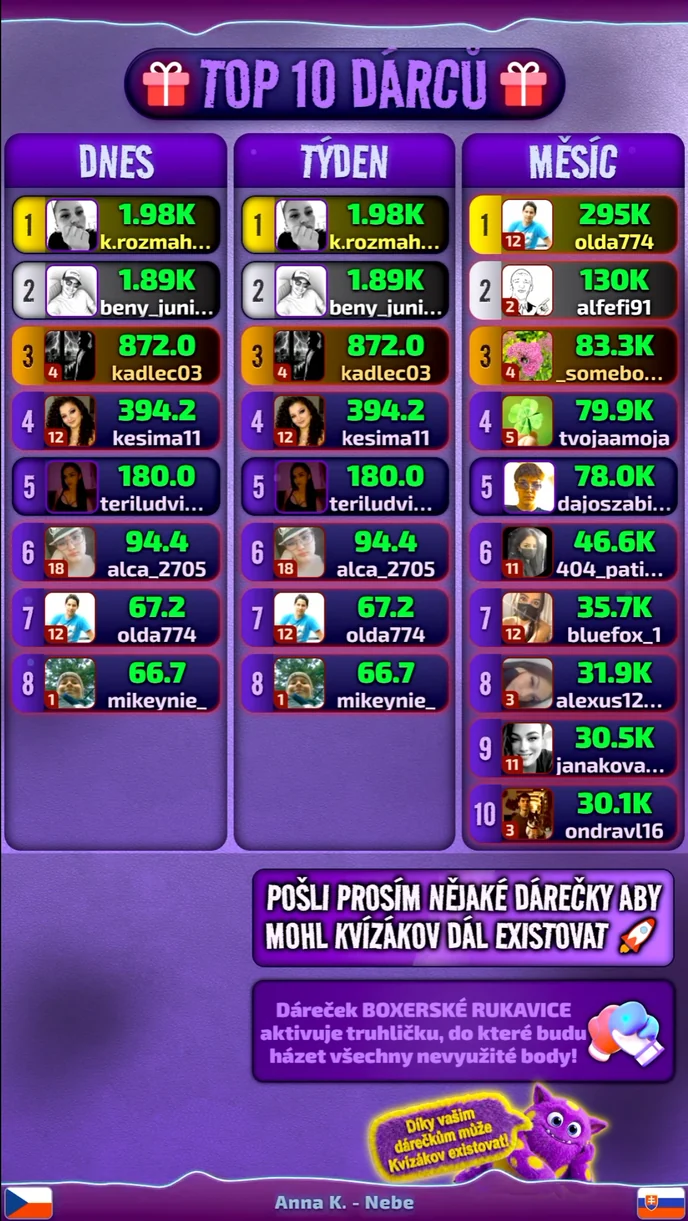
It opens with video straight from a broadcast, followed by screenshots in the order a player meets them during a game. Everything here comes from live production, nothing is staged.
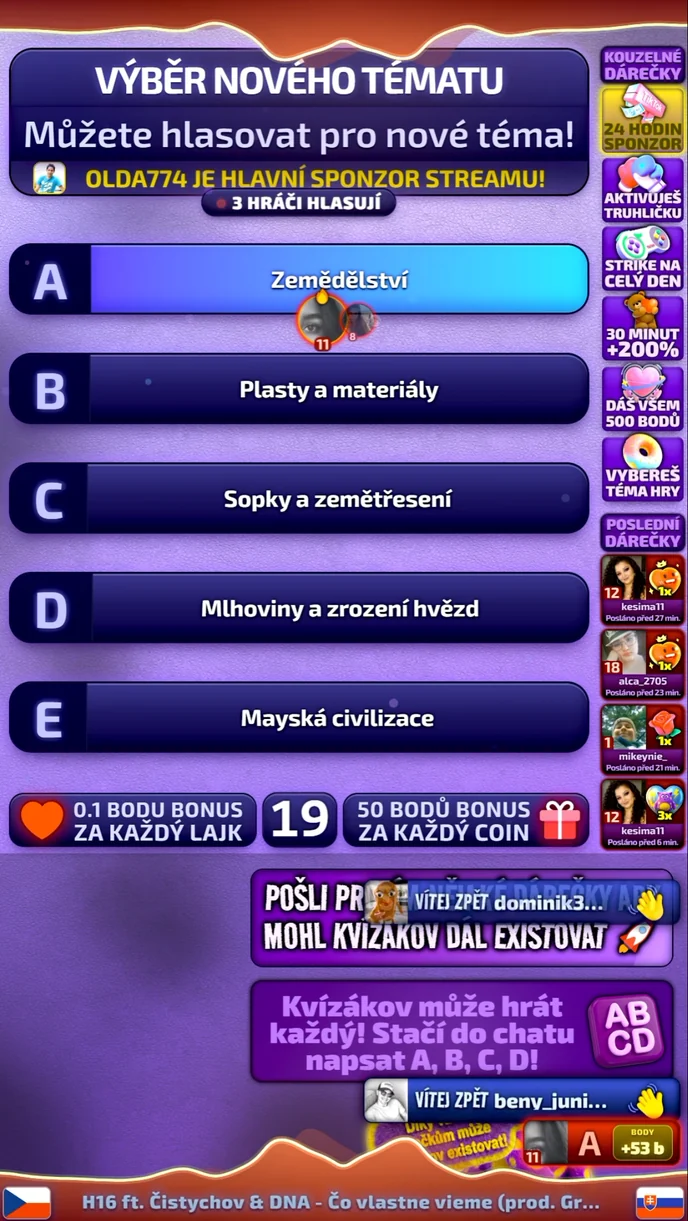

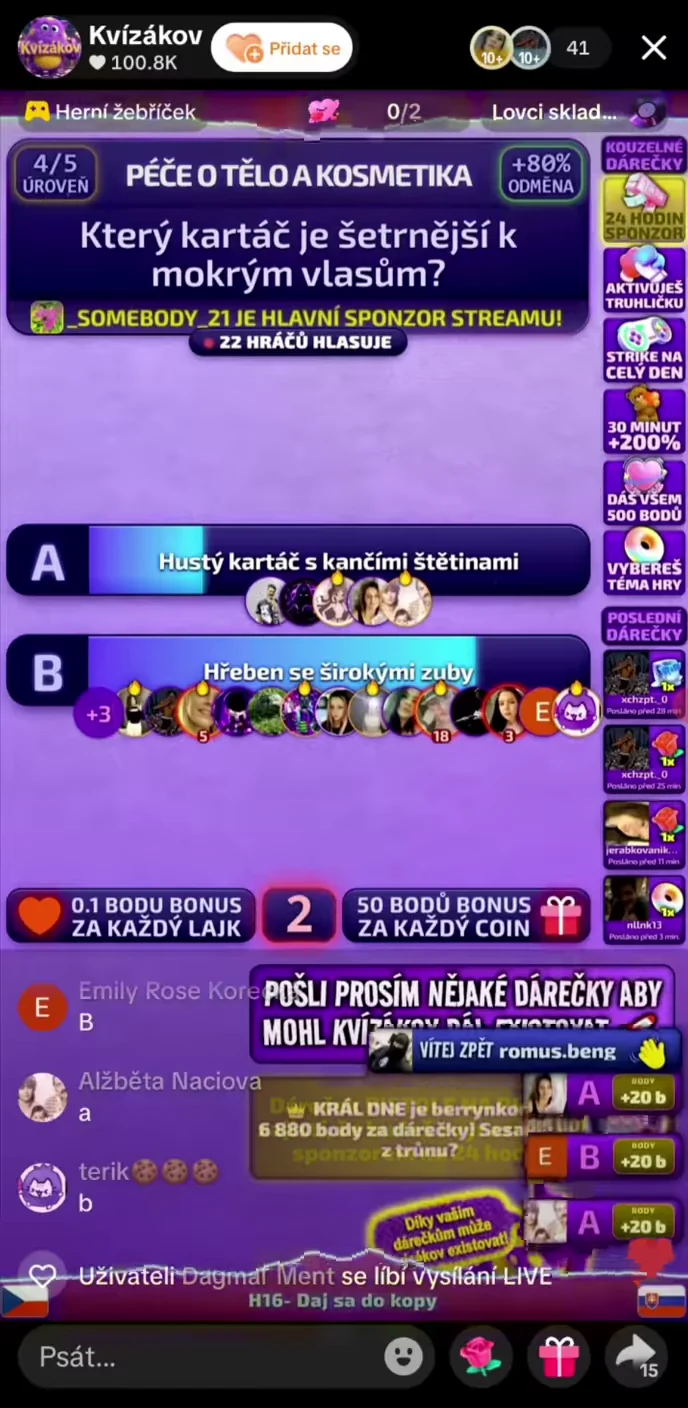
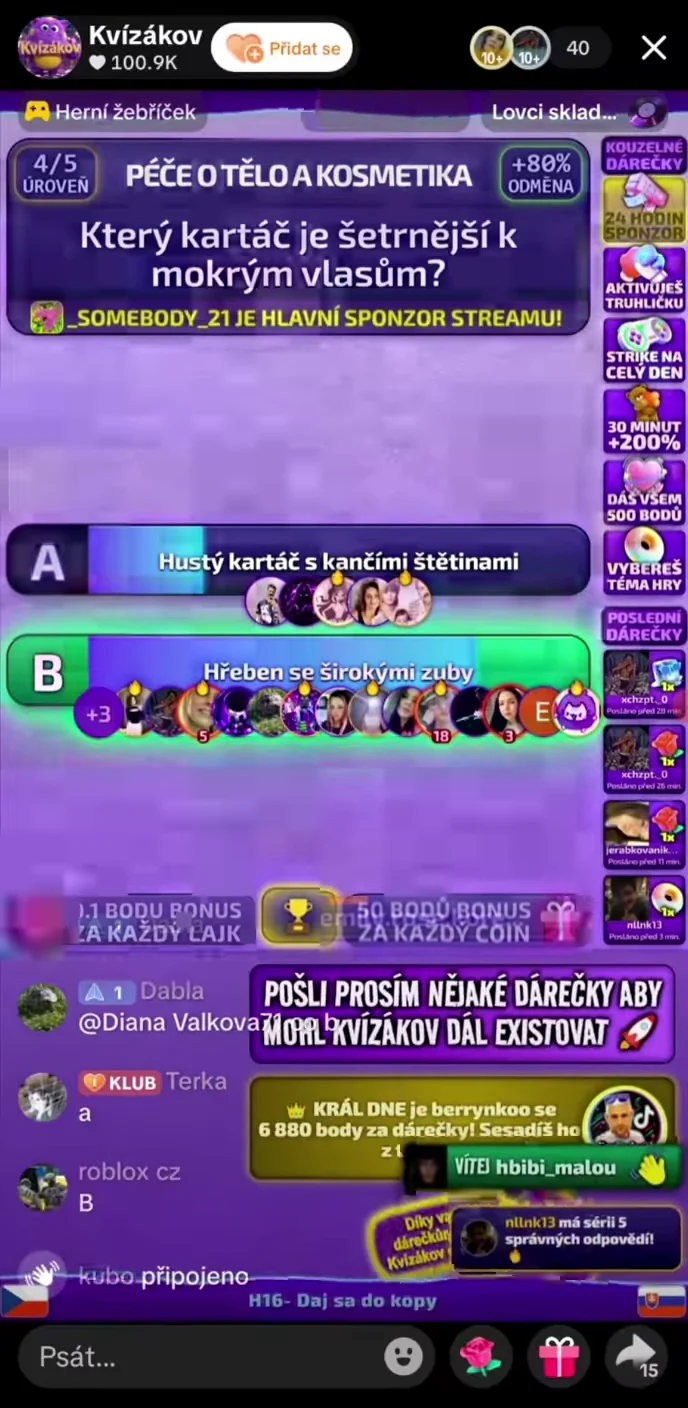
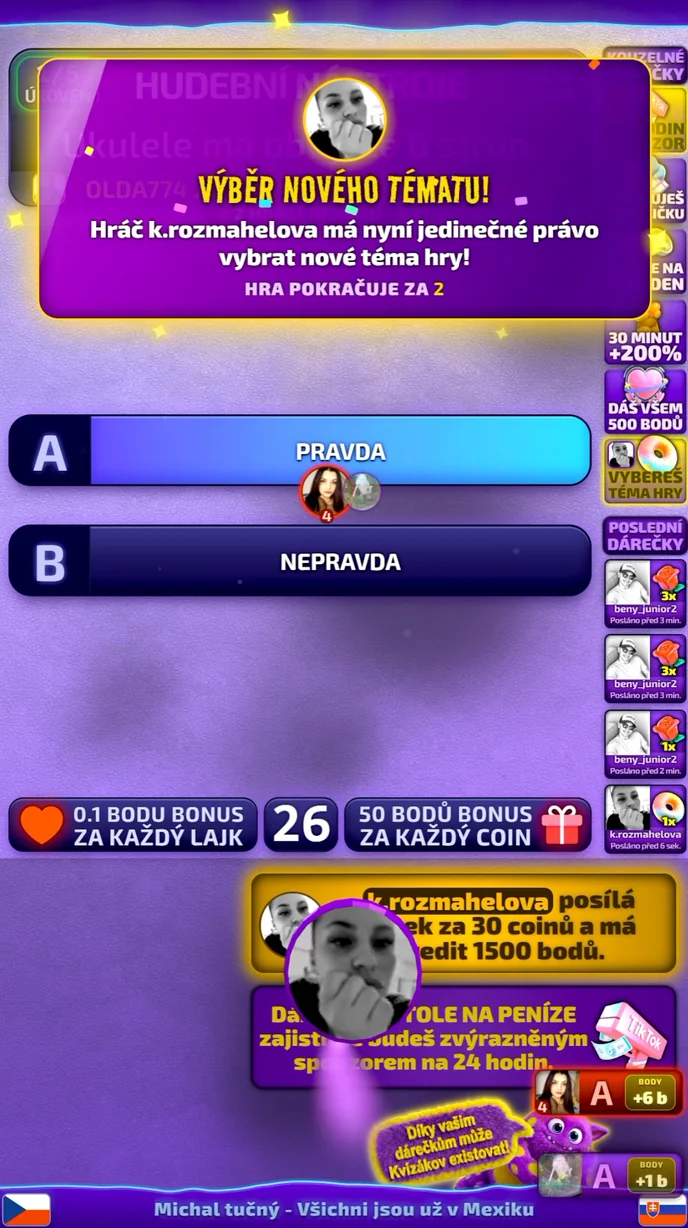
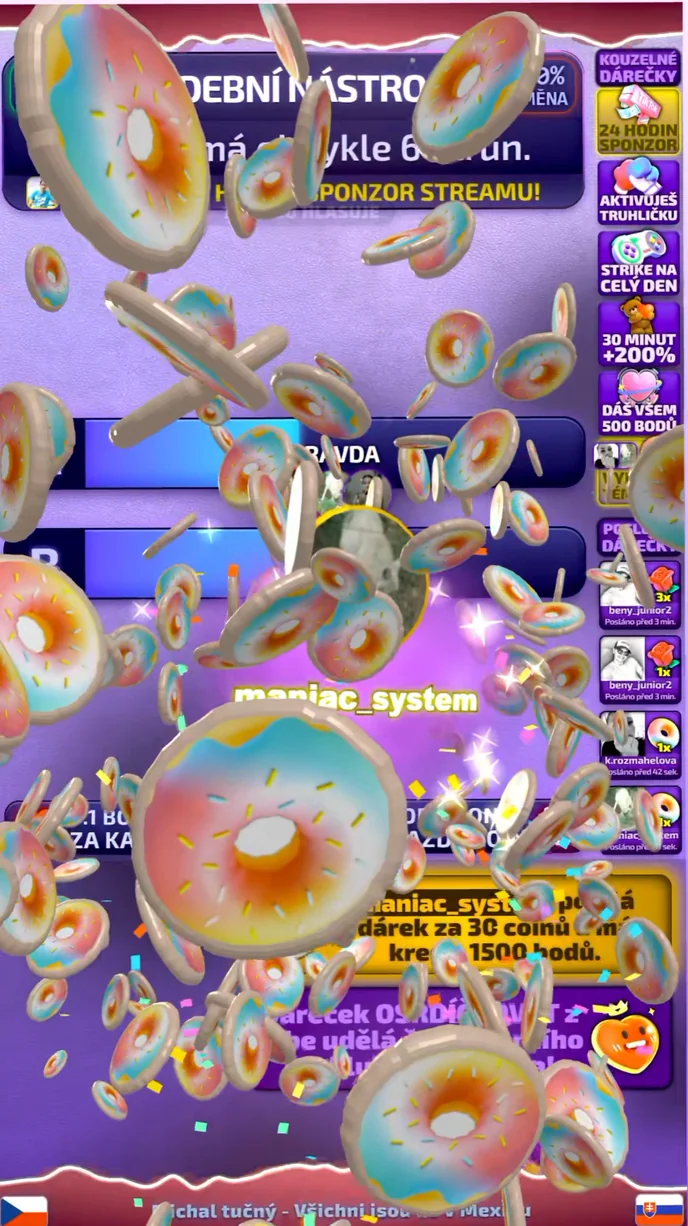
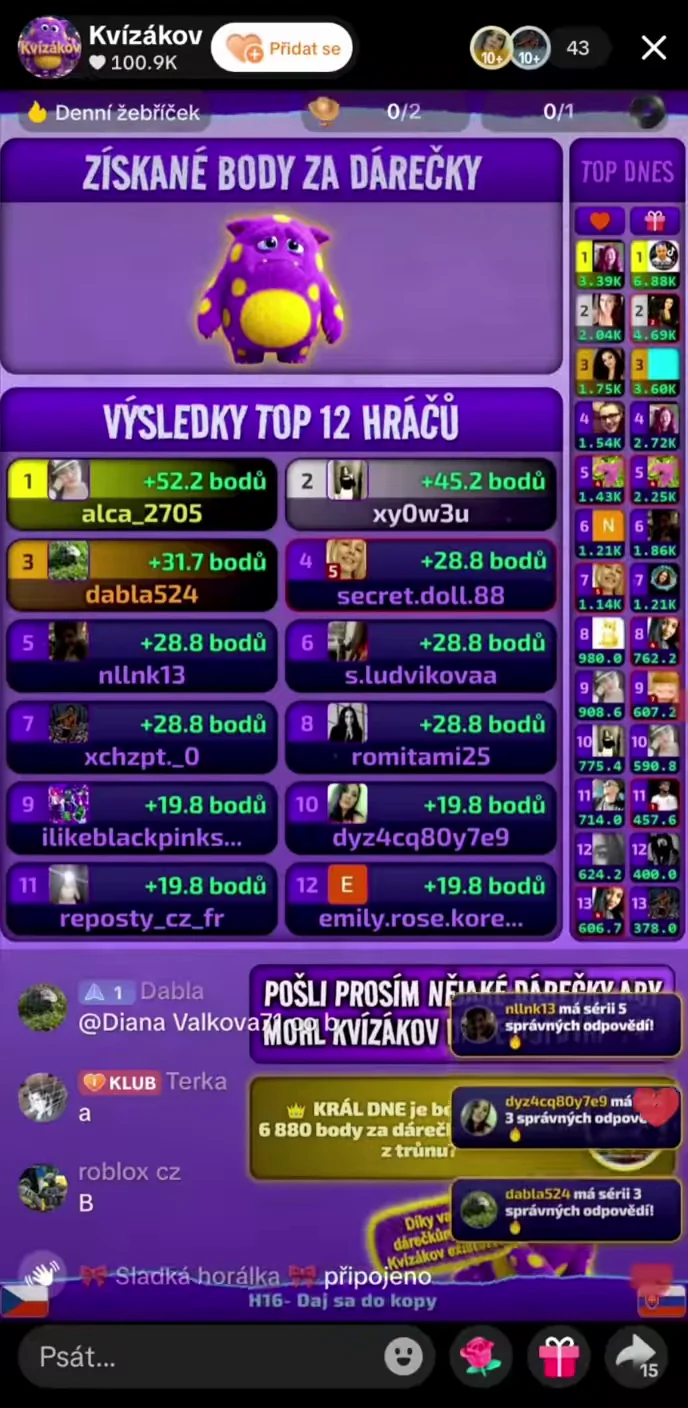
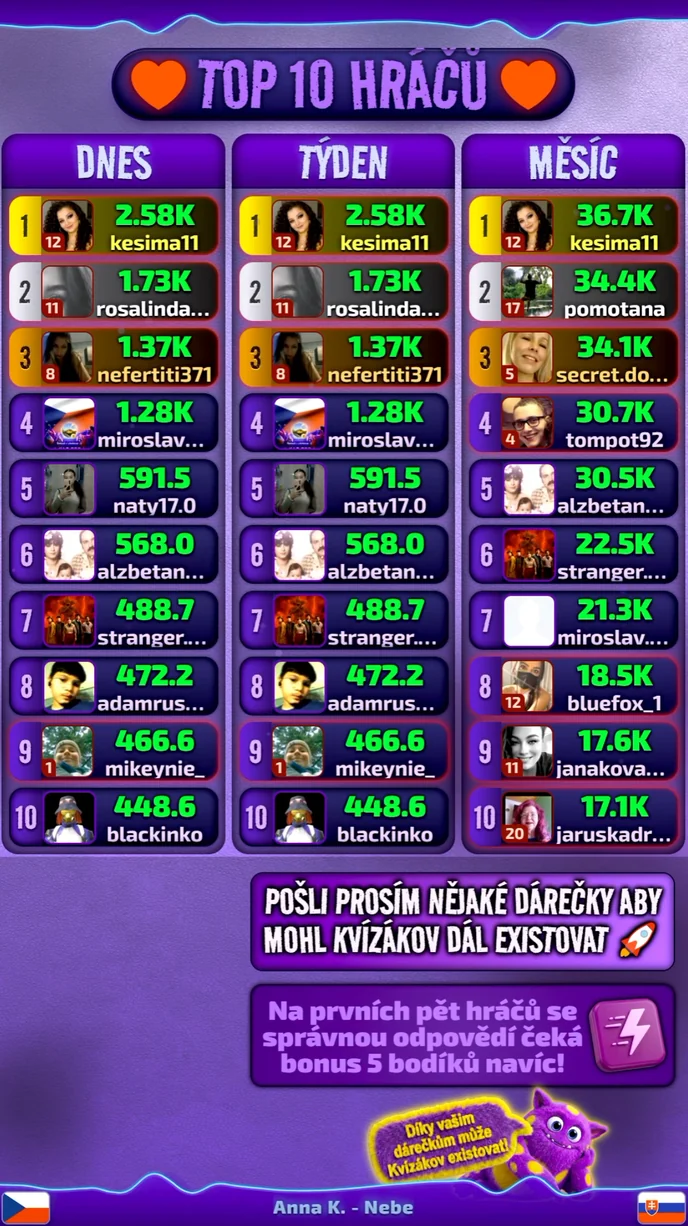
The best demo is the live one. You can find the game on the TikTok channel @kvizakov, where we broadcast almost every day in the afternoon and evening.
From the moment a player types a letter to the moment they see their avatar on screen, the input passes through four layers.
A client connected to the TikTok Live event stream receives comments, likes, gifts, joins and fan club memberships. Events arrive asynchronously and in bursts, so the input queue has to survive spikes without dropping a single vote.
A Python service holds the entire game state: the current question, the votes, gift stakes, streaks, multipliers, the treasure chest and the leaderboards. It also drives round timing and topic selection from the question database.
A browser connected over WebSocket receives state changes and paints them onto a canvas. Heavy effects such as fireworks run in a dedicated Web Worker so the main thread keeps a steady frame rate even when chat traffic peaks.
The output of the rendering layer goes into the streaming software and from there back out to viewers. The loop closes: a player sees their own input as part of the show they are watching.
Everything below is finished and runs in every broadcast.
The game accepts a letter or the full answer typed out in words. The text variant is matched tolerantly against typos and diacritics, and rewards the player with twenty times the base score.
A base score, bonuses for likes, speed, streaks and fan club level, then a multiplier for the question level. Gifts convert into stakes that either return with interest or fall into a shared treasure chest.
Six selected gifts work like game cards: sponsor of the day, treasure chest activation, an all day streak, a half hour multiplier for the whole chat, a bonus for everyone and a topic pick.
Running standings, daily, weekly and monthly boards, a crown for the biggest gifter of the day and persistent player statistics across broadcasts.
Every question and answer is converted to speech, so the game can be played by ear. The voice is synchronised with the round timer.
Fireworks carrying the gifter's avatar, screen shakes on large gifts, a music visualiser reacting to the audio and a colour scheme driven by the real elevation of the sun over Czechia.
No framework scaffolding. Server logic in Python, rendering in vanilla JavaScript on a canvas, a WebSocket in between. Owning the code gives me control over every frame, which matters when a broadcast runs six hours straight.
Kvízákov is past the prototype phase. It runs publicly, daily and with real players. The next steps take it beyond a single channel.
One revenue stream today, a second one ahead that does not depend on a single channel or a single platform.
Viewers send virtual gifts during the game, and TikTok shares their value with the broadcaster. In Kvízákov every gift has a game effect: it converts into a points stake, and selected gifts act as spells that change the whole stream.
That connection is exactly why gifts do not go unnoticed here. The viewer gets a gameplay advantage and a visible tribute on screen rather than a thank you.
The engine is written so that it is not tied to one channel. Questions, language, graphics and rules are separated from the game core. The goal is to offer it to other creators, brands and media companies as a finished product for their own interactive broadcasts.
The model is a subscription for running an instance plus a share of broadcast revenue. That turns a single show into a tool capable of running on hundreds of channels at once.
Why quizzes. A knowledge game is the one format that works regardless of the age of the audience, localises by swapping the question database, and naturally brings players back daily. The engine itself is not tied to quizzes.
From the first broadcast on 1 September 2025 until today, measured on the @kvizakov channel.
We broadcast almost every day. Open the stream and watch the engine work with real players in real time, not in a recorded video.